
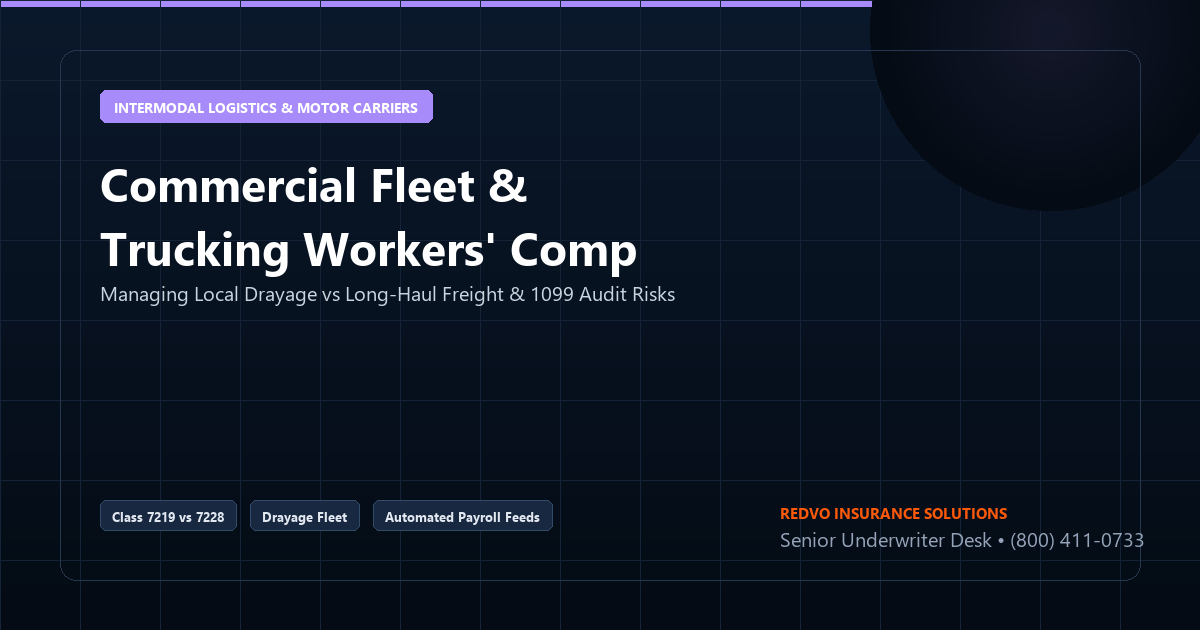
Managing workers’ compensation for commercial motor carriers and intermodal drayage fleets: long-haul vs local driver classification, 1099 vs W-2 exposure, and automated payroll feeds.
Underwriting Complexities in Commercial Fleet Transportation
Commercial trucking, freight distribution, and intermodal container drayage represent critical lifelines of the American supply chain. However, motor carriers face complex workers’ compensation requirements due to interstate transit, varying state benefit jurisdictions, and severe vehicular liability risks.
Underwriters evaluate loss frequency, driver motor vehicle records (MVRs), vehicle maintenance protocols, and electronic logging device (ELD) data to determine account acceptability and rating credits.
Classification Code Accuracy: Local Drayage vs Long-Haul Trucking
Proper payroll classification is essential for motor carriers. Misclassifying drivers can lead to devastating retroactive premium adjustments during year-end audits:
- Class Code 7219 (Local Trucking / Drayage): Applies to drivers operating within a defined metropolitan radius (typically under 200 miles), returning to the home terminal daily. Often carries lower statutory rates than long-haul transit.
- Class Code 7228 (Long-Haul / Over-the-Road Freight): Applies to interstate, sleeper-cab, and line-haul operations involving cross-country routes and overnight staging.
- Warehouse, Loading Dock & Maintenance Payroll: Freight handlers, dispatchers, and diesel mechanics must be segregated on payroll records; otherwise, their wages may be classified at higher driving rates.
1099 Independent Contractor Reclassification Exposure
State regulatory bodies and insurance carrier auditors aggressively scrutinize independent owner-operators. If an auditor determines that an owner-operator does not meet statutory independent business entity tests (such as California’s AB 5 or federal Department of Labor economic realities criteria), the carrier will retroactively assess workers’ comp premium on the total 1099 payments issued to that driver.
To eliminate this catastrophic audit risk, motor carriers must maintain strict vendor compliance files, verify that sub-haulers carry their own active workers’ comp or occupational accident policies, and secure formal certificates of insurance prior to dispatch.
Eliminate Year-End Cash Drains with Pay-As-You-Go
Fluctuating freight volumes mean seasonal payroll swings. Traditional estimated policies create chronic cash flow bottlenecks. Redvo connects motor carriers with automated Pay-As-You-Go Trucking Workers’ Comp programs that pull real-time payroll data directly from your accounting or dispatch system, ensuring exact premium payments every month.
Speak with our specialized transportation underwriting desk in Fontana, CA at 1-800-411-0733 or explore our dedicated Trucking & Freight Workers’ Comp Program.
Recent Statutory Guides
Need Same-Day Workers' Comp?
Direct senior broker underwriting for staffing, solar, and trucking across all 50 states.
Call (800) 411-0733 WhatsApp Underwriter