
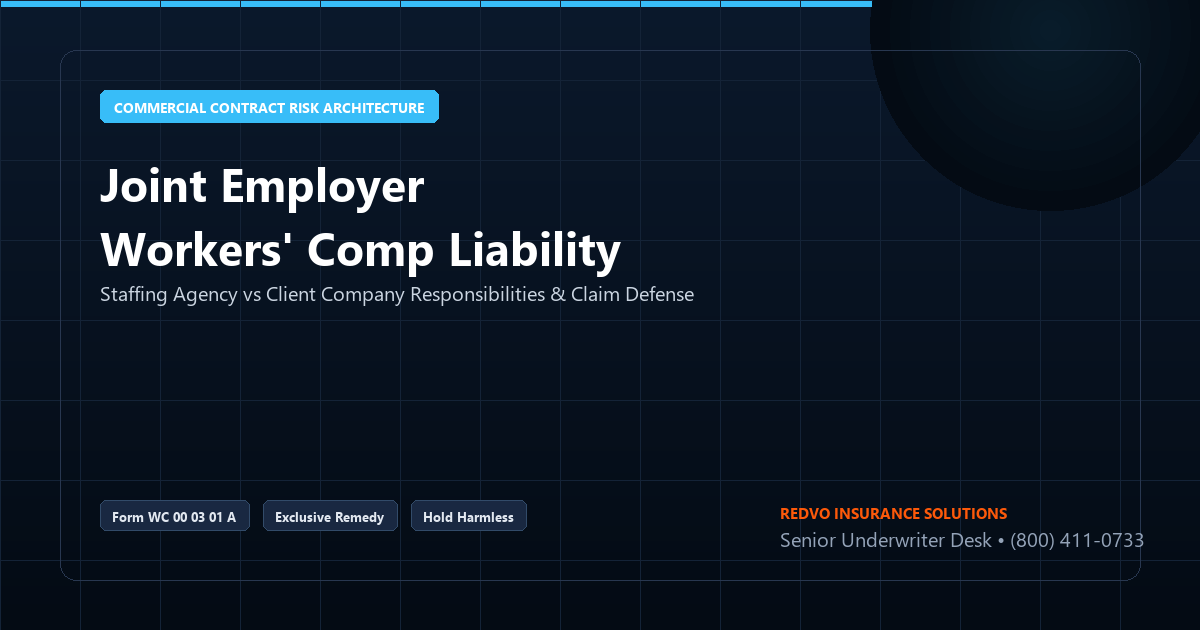
Who is legally liable when a temporary worker is injured at a client facility? An analysis of general vs special employer obligations, exclusive remedy protection, and certificate endorsements.
The Legal Reality of General vs Special Employers
In commercial staffing arrangements, liability for workplace injuries is governed by the joint employment doctrine. Under state workers’ compensation statutes nationwide, a temporary staffing agency and its host client share distinct legal responsibilities:
- The General Employer (Staffing Agency): Holds the employment contract, issues W-2 forms, withholds payroll taxes, and carries statutory workers’ compensation insurance covering the worker.
- The Special Employer (Client Company): Controls the physical work environment, directs daily tasks, provides on-site personal protective equipment (PPE), and manages direct occupational safety.
Exclusive Remedy Protection & Third-Party Lawsuit Risks
Under state workers’ compensation laws, the Exclusive Remedy doctrine prevents injured workers from suing their direct employer for personal injury damages; their sole financial recourse is statutory workers’ comp benefits (medical treatment, temporary disability, and permanent impairment awards).
However, if the staffing agreement is improperly drafted or lacks the appropriate insurance endorsements, an injured worker may claim their statutory workers’ comp benefits from the staffing agency and simultaneously file a devastating third-party negligence lawsuit against the client company. To close this legal loophole, commercial staffing firms must integrate two key elements:
- Alternate Employer Endorsement (WC 00 03 01 A): Formally binds the client company as an alternate employer under the staffing agency’s policy, extending exclusive remedy protection to both parties.
- Mutual Hold Harmless & Indemnification Agreements: Contractual terms clearly outlining that the client must provide a safe workplace matching the agreed-upon job duties, and cannot reassign workers to unapproved high-hazard tasks without prior written authorization.
Immediate Action Protocol Following an On-Site Injury
When an injury occurs at a client job site, delayed reporting is the #1 reason claims escalate into disputed litigation. Staffing agencies should mandate the following protocol:
- Immediate First Aid & Medical Treatment: Direct the injured worker to an approved occupational medical clinic within the carrier’s Medical Provider Network (MPN).
- Mandatory 24-Hour Notice: The client supervisor must notify the staffing agency’s risk manager within 24 hours of the incident.
- Joint Incident Investigation: Complete an objective incident report documenting witness statements, equipment involved, and adherence to safety protocols.
- Direct Broker Claims Notification: File the First Report of Injury (FROI) with your insurance carrier promptly to initiate wage replacement and mitigate litigation exposure.
Consult Our Commercial Risk Underwriters
Redvo Insurance Solutions helps commercial staffing agencies craft bulletproof insurance structures that protect both placement firms and host clients. Call our licensed senior brokers at 1-800-411-0733 or submit an inquiry through our contact desk.
Recent Statutory Guides
Need Same-Day Workers' Comp?
Direct senior broker underwriting for staffing, solar, and trucking across all 50 states.
Call (800) 411-0733 WhatsApp Underwriter