
Welcome Redvo Insurance Solutions
Welcome Redvo Insurance Solutions
Call Us Now
+1800-411-0733
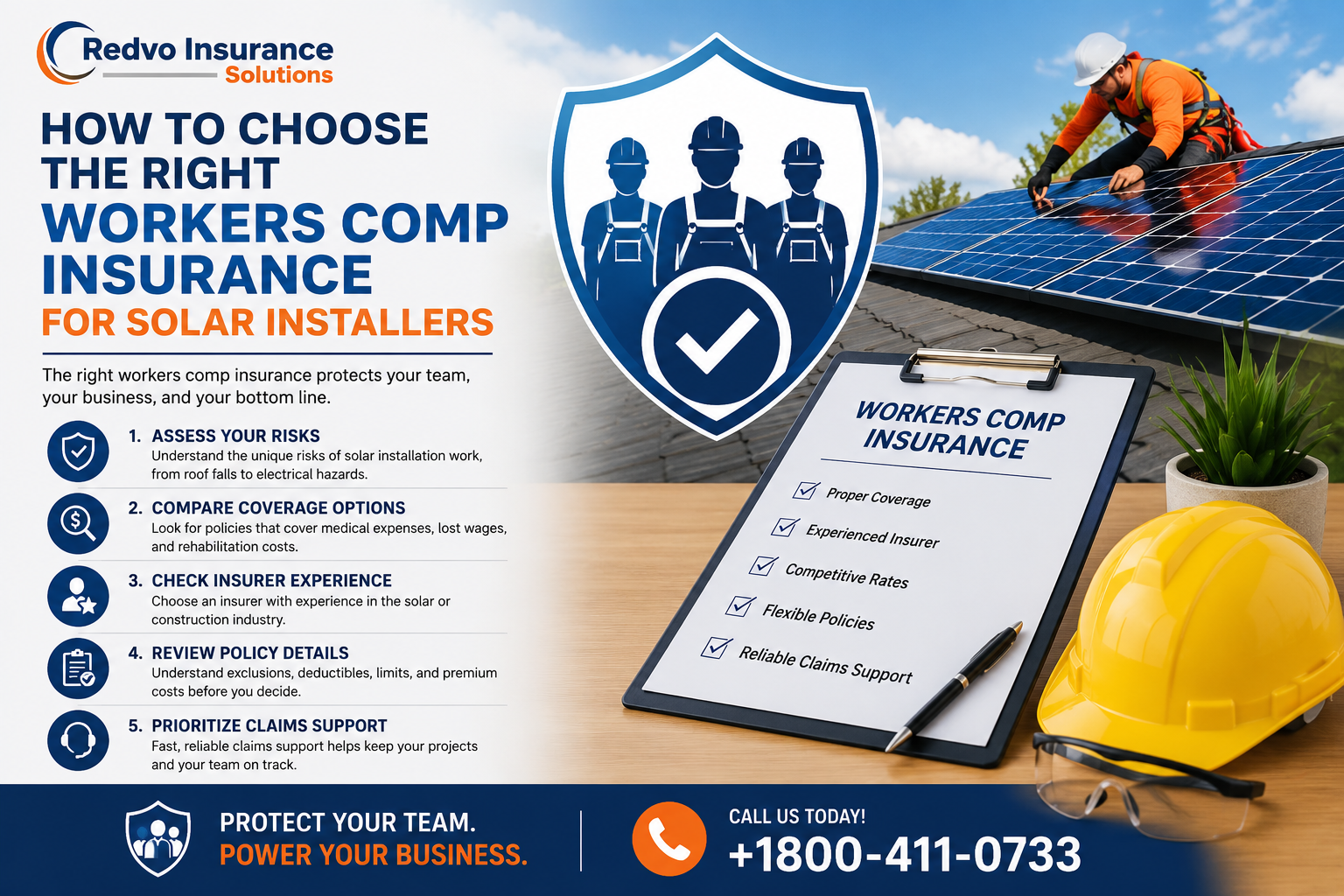
Solar installation businesses face many workplace risks. Employees may work on rooftops, climb ladders, handle heavy solar panels, and use electrical tools. They may also work outdoors during extreme heat or changing weather.
These risks make workers comp insurance for solar installers an important part of business protection. Workers compensation can provide benefits for qualifying work-related injuries and illnesses. Requirements and benefits vary by state.
Choosing the right policy requires more than finding the lowest price. Solar contractors should consider employee duties, payroll, classifications, locations, subcontractors, claims history, and state requirements.
Redvo Insurance Solutions has 15+ years of experience helping businesses understand their insurance needs. Our trusted approach focuses on practical coverage, clear guidance, and protection that matches your business operations.
Workers compensation insurance helps provide benefits when an employee suffers a qualifying work-related injury or occupational illness.
Depending on state law, benefits can include medical treatment, wage replacement, rehabilitation, and disability benefits. Some claims may also provide death benefits to eligible dependents.
Solar installation creates specific workplace exposures. Installers may work on residential roofs, commercial buildings, construction sites, and ground-mounted solar systems. They may also carry heavy panels, use ladders, operate power tools, and work around electrical systems.
NCCI explains that contractor applications should provide details about the type of work performed, equipment used, and subcontracting activities. Accurate information helps insurers evaluate the business properly.
The policy should reflect the actual work performed by your employees. Incorrect business information can create coverage and classification problems.
Solar installation combines several physical and environmental risks. Falls remain an important concern because many installers work at elevated locations. Electrical work can also expose employees to shock, burns, and other injuries.
Workers may also suffer injuries while lifting solar panels or moving equipment. Repetitive movements can contribute to strains and other physical problems. Outdoor solar workers can face heat exposure during long summer shifts. Weather conditions can also make certain job sites more difficult to manage.
A workplace injury can affect both the employee and the business. The employee may need medical treatment and time away from work. The business may need to manage the claim, adjust work schedules, and handle additional administrative tasks.
Workers compensation can help provide applicable benefits for qualifying workplace injuries. It can also help businesses meet applicable state requirements. However, insurance should not replace workplace safety. Solar companies should combine insurance coverage with proper training and safety procedures.
Workers compensation coverage depends on state law, policy terms, and claim circumstances. Generally, workers compensation focuses on qualifying work-related injuries and illnesses.
Workers comp insurance requirements for solar installers vary from state to state. There is no single workers compensation rule covering every solar contractor in the United States.
Requirements may depend on employee count, business structure, employee status, industry, and state law.
The U.S. Department of Labor provides information and contacts for state workers compensation programs. Businesses can use the appropriate state authority to verify current requirements. Solar contractors operating across multiple states need extra attention.
A contractor may have employees working in California, Texas, Arizona, Florida, or other states. Each state can have different workers compensation requirements.
There is no single price for solar installers workers comp insurance cost. Insurers evaluate different factors when determining premiums.
The cheapest policy is not always the best choice. Solar contractors should compare coverage, classifications, service, exclusions, and pricing.
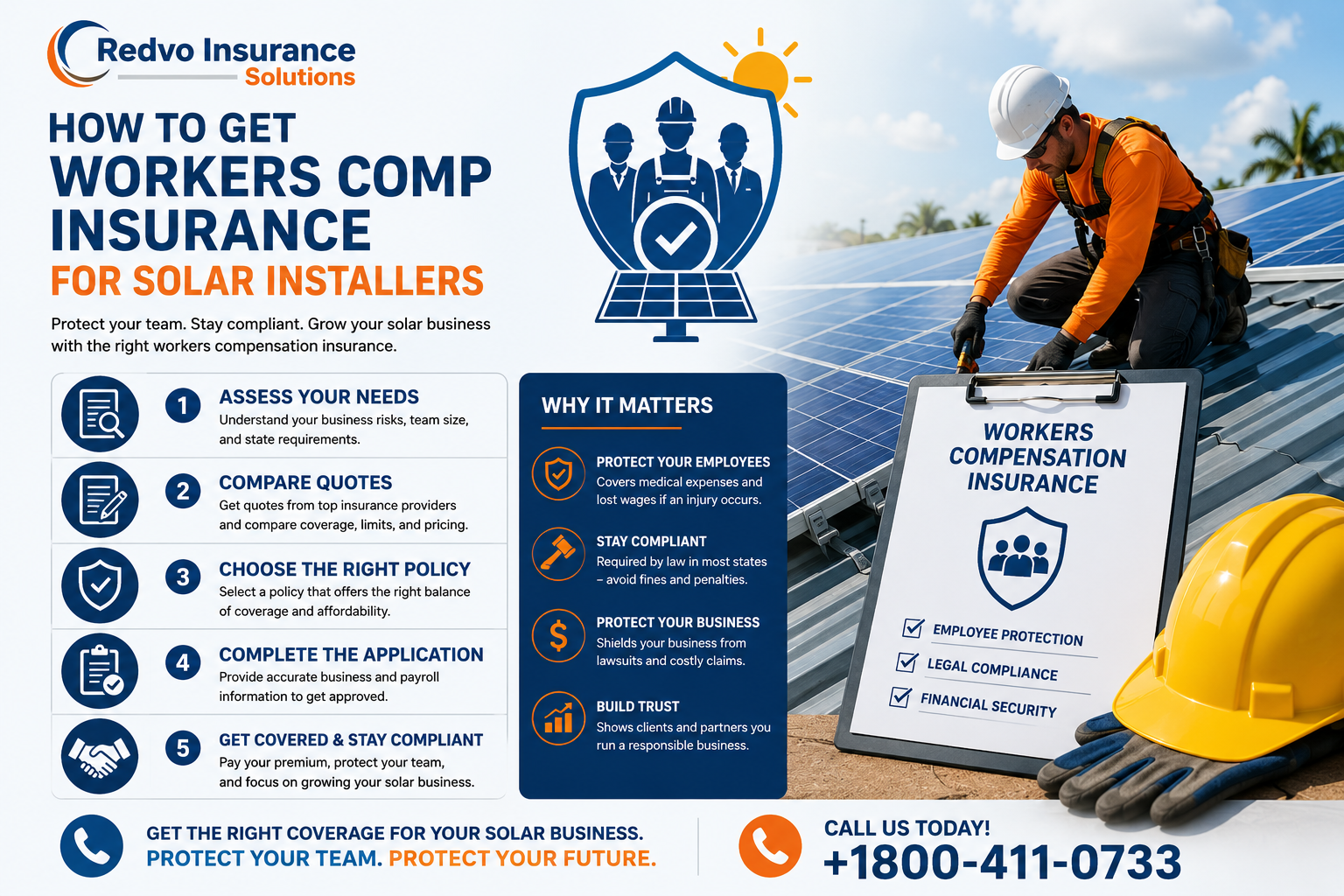
Choosing the right policy becomes easier when you follow a clear process.
Step 1: Understand Your Solar Operations
Start by listing all services your company provides. Include installation, electrical work, maintenance, repairs, rooftop work, and other field activities.
Step 2: Identify Employee Duties
Create a clear list of employee responsibilities. Separate field installers, electricians, supervisors, drivers, and office workers when appropriate.
Step 3: Prepare Accurate Payroll
Gather estimated payroll information for each applicable classification and location. Accurate payroll helps insurers calculate premiums correctly.
Step 4: Check State Requirements
Review workers compensation requirements for every state where your employees work. Use official state resources whenever possible.
Step 5: Review Subcontractor Exposure
Tell your insurance professional about subcontractors. Explain what work they perform and whether they maintain their own insurance.
Step 6: Request Multiple Quotes
Request quotes from qualified insurance professionals. Multiple quotes can help you compare available coverage and pricing.
Step 7: Compare More Than Price
Review coverage, classifications, exclusions, claims service, payment options, and premiums. A cheaper policy may not provide the protection your business needs.
Step 8: Review the Final Policy
Check the business name, locations, classifications, payroll, and operations. Make sure the information accurately represents your business before purchasing.
Getting a workers comp insurance for solar installers quote starts with accurate business information. Prepare your company details before requesting a quote. You may need information about:
Number of employees
Estimated annual payroll
Employee job duties
Business locations
Type of solar work
Claims history
Subcontractors
Previous insurance information
Explain your actual operations clearly. Do not describe your business as a low-risk operation if employees perform high-risk field work. An accurate application can help the insurer understand your actual exposure. After receiving quotes, compare coverage and terms instead of looking only at the premium.
Solar contractor workers compensation coverage can help manage the financial impact of qualifying workplace injuries. Imagine an installer falling from a roof during a solar project. The employee may need medical treatment and could miss work for an extended period.
Workers compensation may provide applicable benefits according to state law. The business also needs to report the injury and follow the insurer's claims process. Strong workers compensation coverage can help the company manage these responsibilities. However, prevention remains equally important.
Solar contractors should provide safety training and proper protective equipment. Employees should understand fall protection, electrical safety, ladder safety, equipment handling, and heat protection. OSHA provides solar industry guidance covering several of these workplace hazards.
Workers compensation and general liability insurance protect against different risks.
|
Workers Compensation |
General Liability |
|
Focuses on qualifying employee injuries |
Focuses mainly on third-party claims |
|
Can provide medical benefits |
Can address covered third-party bodily injury |
|
Can provide wage-related benefits |
Can address certain property damage claims |
|
Governed largely by state workers compensation laws |
Governed by policy terms and applicable law |
|
Designed for employee workplace injuries |
Designed for business liability exposures |
There is no guaranteed premium reduction for every solar contractor. However, businesses can improve their risk management and maintain accurate insurance information.
To buy workers comp insurance for solar contractors, start with your actual business exposure.
First, identify your employees and their duties.
Next, check applicable state requirements.
Then prepare payroll, location, operations, claims, and subcontractor information.
After that, request quotes from qualified insurance professionals.
Compare each quote based on coverage, classification, exclusions, service, and price.
Finally, review the policy before purchasing.
Do not select a policy simply because it has the lowest premium. The right policy should match your actual solar installation operations.
Choosing the right workers comp insurance for solar installers requires careful attention to your business operations. Do not choose coverage based only on premium price.
Review your employee duties, payroll, classifications, locations, subcontractors, claims history, and state requirements. Then compare suitable insurance options based on coverage and service.
Your workers compensation policy should reflect the actual risks your employees face on solar projects. Strong safety practices should also remain a key part of your business strategy.
Workers compensation is only one part of a complete solar contractor insurance plan. Depending on your operations, you may also need general liability, commercial auto, equipment, or other business coverage.
Requirements can change between states and over time. Always verify current requirements with the appropriate state workers compensation authority. With 15+ years of experience, Redvo Insurance Solutions provides trusted guidance to help solar businesses understand their workers compensation needs.
The right coverage can help protect your employees and support your business when unexpected workplace injuries occur. A careful insurance review today can help your solar company stay better prepared for future projects.
Many solar businesses with employees need workers compensation insurance. Exact requirements depend on state law, employee count, worker status, and business structure.
Costs vary based on payroll, employee classifications, location, claims history, operations, and other underwriting factors. Each solar business receives pricing based on its risk profile.
Workers compensation generally covers qualifying work-related injuries and occupational illnesses. Benefits can include medical care, wage replacement, rehabilitation, disability benefits, and other state-required benefits.
Requirements vary by state. Solar contractors should check their state workers compensation authority for current rules covering employees, exemptions, contractors, and proof of coverage.
Provide accurate payroll, employee duties, locations, operations, claims history, and subcontractor information. An insurance professional can use this information to provide suitable quote options.
Not automatically. Subcontractor treatment depends on state law, contracts, worker status, and insurance arrangements. Contractors should verify subcontractor coverage and maintain current insurance certificates.
No. Solar panel installer insurance can describe several business policies. Workers compensation specifically focuses on qualifying employee workplace injuries and related benefits.
Qualifying work-related electrical injuries may receive workers compensation benefits. Coverage depends on state law, policy terms, injury circumstances, and claim eligibility.
That depends on applicable state requirements and business circumstances. Contractors should verify their legal obligations before operating without workers compensation coverage.
Compare coverage, classifications, state compliance, exclusions, claims service, insurer stability, and premiums. Choose coverage that matches your actual solar installation operations.








It is a long established fact that wo will be distracted by the readable content as when looking at its layout.
© 2026 Redvo Insurance Solutions All rights reserved